- The Lindy Newsletter
- Posts
- Downward Mobility
Downward Mobility

Paul Skallas
March 23, 2026
Are you optimistic about the future?
If you are American, you probably are. You expect tomorrow to be better than today, next year better than this one. However, most societies don’t think this way.
Other societies remember famine, war, occupation, inflation, collapse. They remember that what rises can also fall, and their language carries that memory. You often only realize how unusual the American outlook is after living abroad for a while.
Americans adopt new technology faster than anyone. They try new medical procedures, new platforms, new financial instruments, new ways of living. Other societies wait to see if things work. Americans go first. They use credit at rates that baffle other cultures.
Look at the language. American English is a language of upward trajectory. We are always supposed to be doing well, and the future is always bright. Even our basic greetings, the "Great!" and "Wonderful!" carry upward movement. This irritated Polish director Krzysztof Kieslowski.
To him, it felt fake. To us, it’s realism.
Some of it is self-selection. The pessimists stayed home. Everyone who got on the boat to America believed the future was worth betting everything on, worth leaving your language, your family and your country.
But the deeper reason, I think, is that America is psychologically built around upward mobility. For most of its history, the future really did improve. Each generation could plausibly expect more than the one before it.
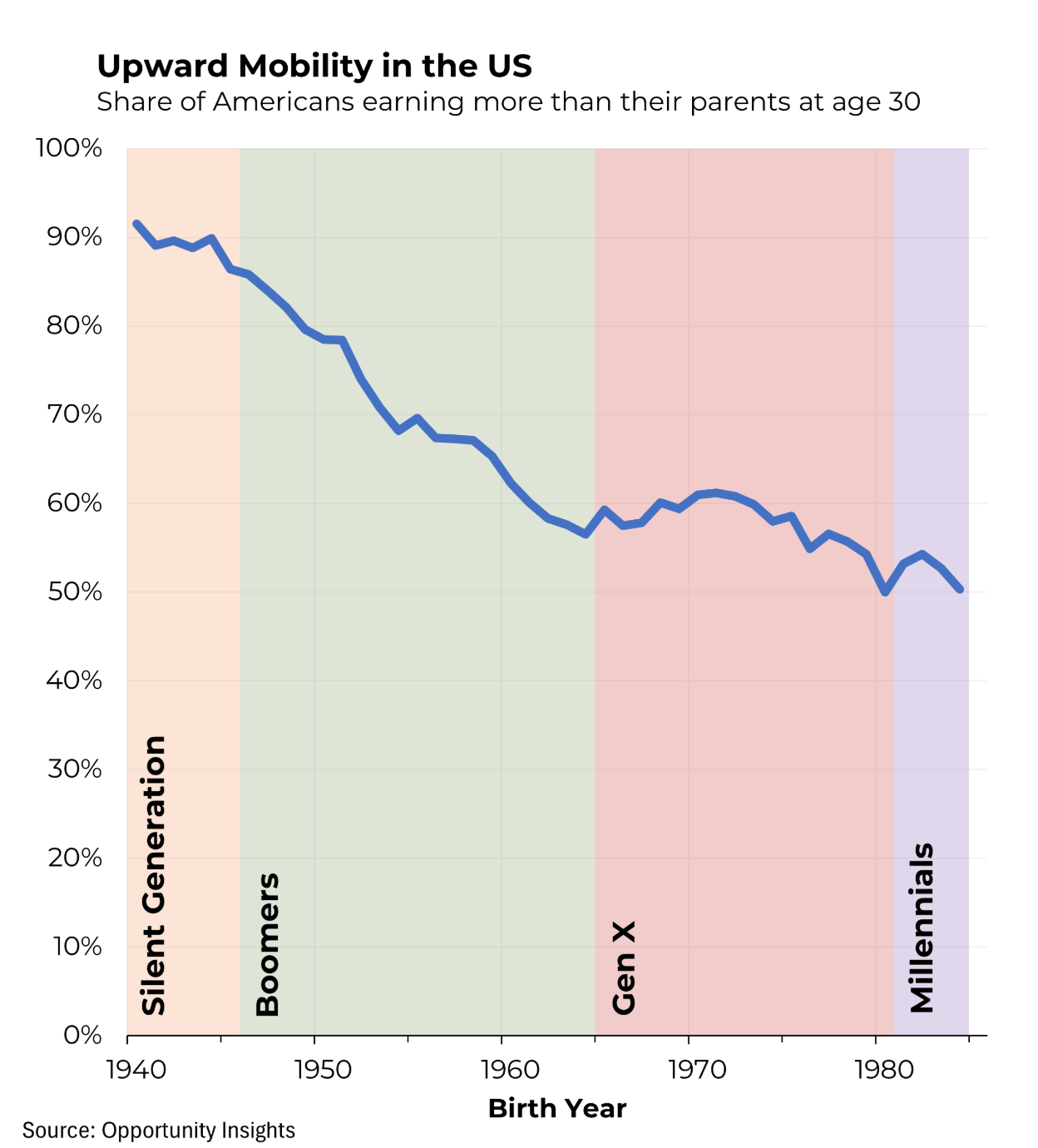
That is now becoming a problem. Upward mobility no longer feels automatic in America. 90% of the Silent Generation earned more than their parents. 50% of Millennials do.
You can already see it getting worse in the job market, which has deteriorated sharply in just a few years. Only 54% of the Class of 2024 secured full-time work within six months, a drop from over 57% in 2023 and 59% in 2022. Things aren’t looking good in 2026 either.
A growing class of educated young people entering adult life on a downward slope.
America may have to adjust to downward mobility becoming ordinary.
Not A Place for Decline
Downward mobility is not unnatural. Some degree of it is normal at the start of adult life. Almost everyone leaves the abundance of childhood and enters a world that feels narrower, more constrained, less forgiving.
And for most of human history, people lived in roughly the same circumstances as their parents. If your father was a blacksmith, you were likely a blacksmith. Life was cyclical, not linear. Most societies built their emotional lives around the assumption that stability without growth was normal.
The problem is America never did that.
America is built around ascent. Instead of fighting over how to divide a fixed pie, the solution was to make a bigger one. Even our attitude toward debt is like this. Here’s Jeff Bezos saying that the answer to debt isn’t to cut, the answer is to just make more money.
America has almost no cultural scaffolding for downward mobility. Even our worst insult reveals the culture. We call people losers. The word assumes life is a ladder and the worst thing you can be is someone who fell.
The whole country runs on the line going up. If the line goes down things get ugly quick. You don’t want to fall too many classes below in America. You are entering a completely different world.
The New Characters of Decline
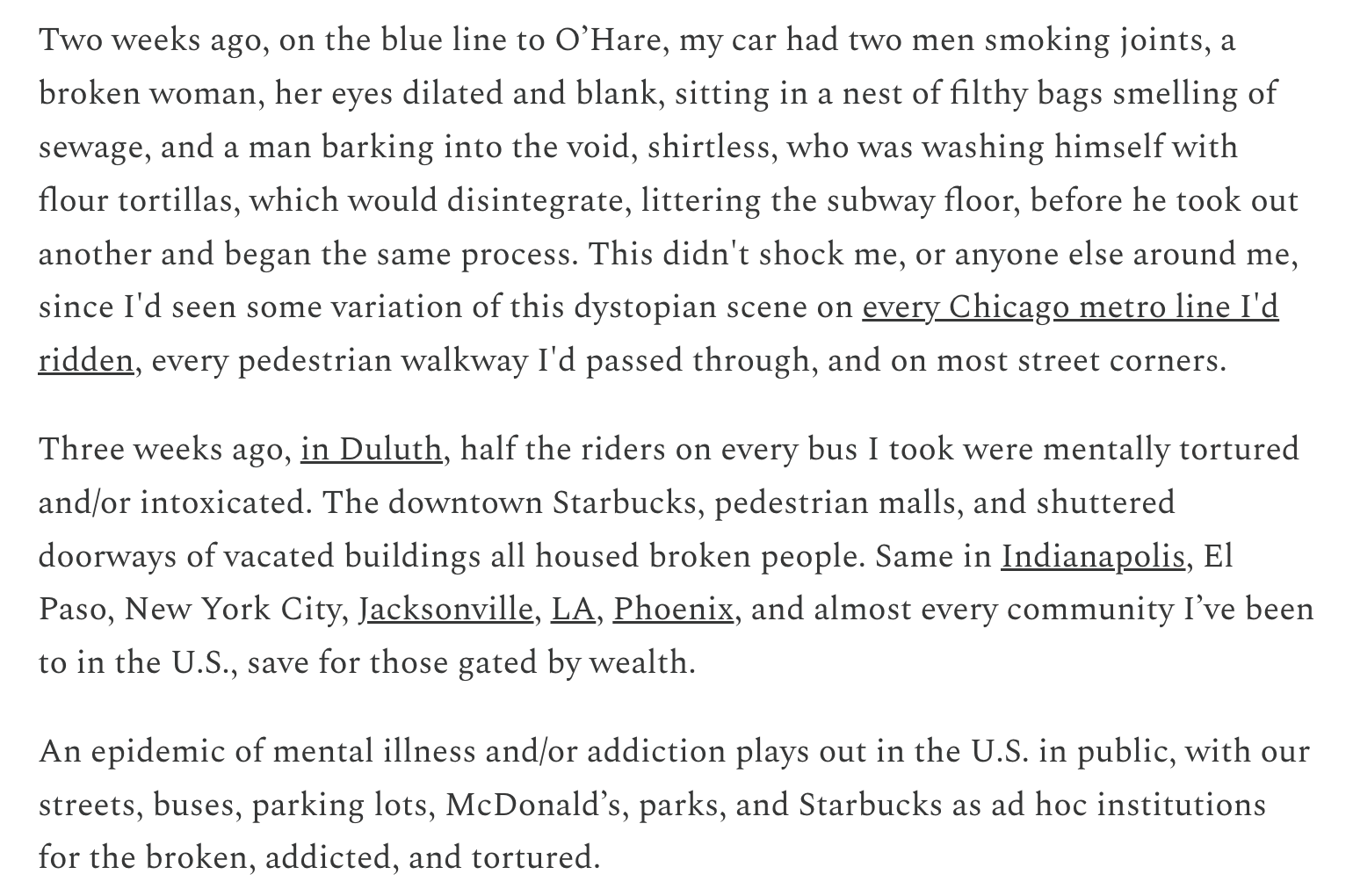
We can even see how downward mobility is creating a new set of characters.
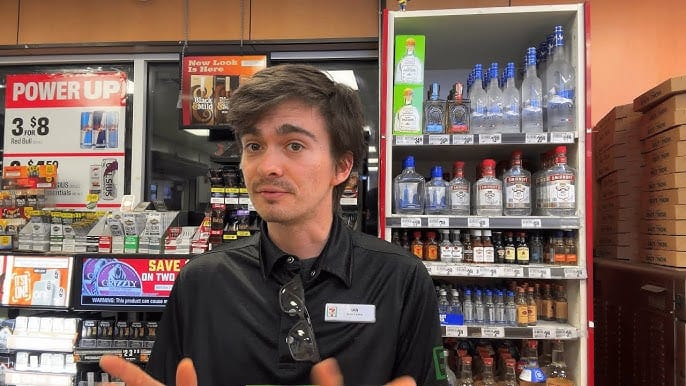
The downwardly mobile but highly self-aware narrator. He is smart, articulate, clearly capable of more, yet living a life that falls below his apparent potential. He works retail, stocks shelves, drifts between service jobs, and explains himself to the camera with too much fluency to seem properly matched to his circumstances. He seems overqualified for his own life.
In most countries, this would not be especially notable. Travel through Europe, Asia, or South America and you will find intelligent, educated people working ordinary jobs without it carrying much larger meaning. In America, it feels like a category violation. The whole culture runs on the assumption that intelligence plus effort should produce ascent. When it does not, people stare.
The Diner Goth is another version of this.
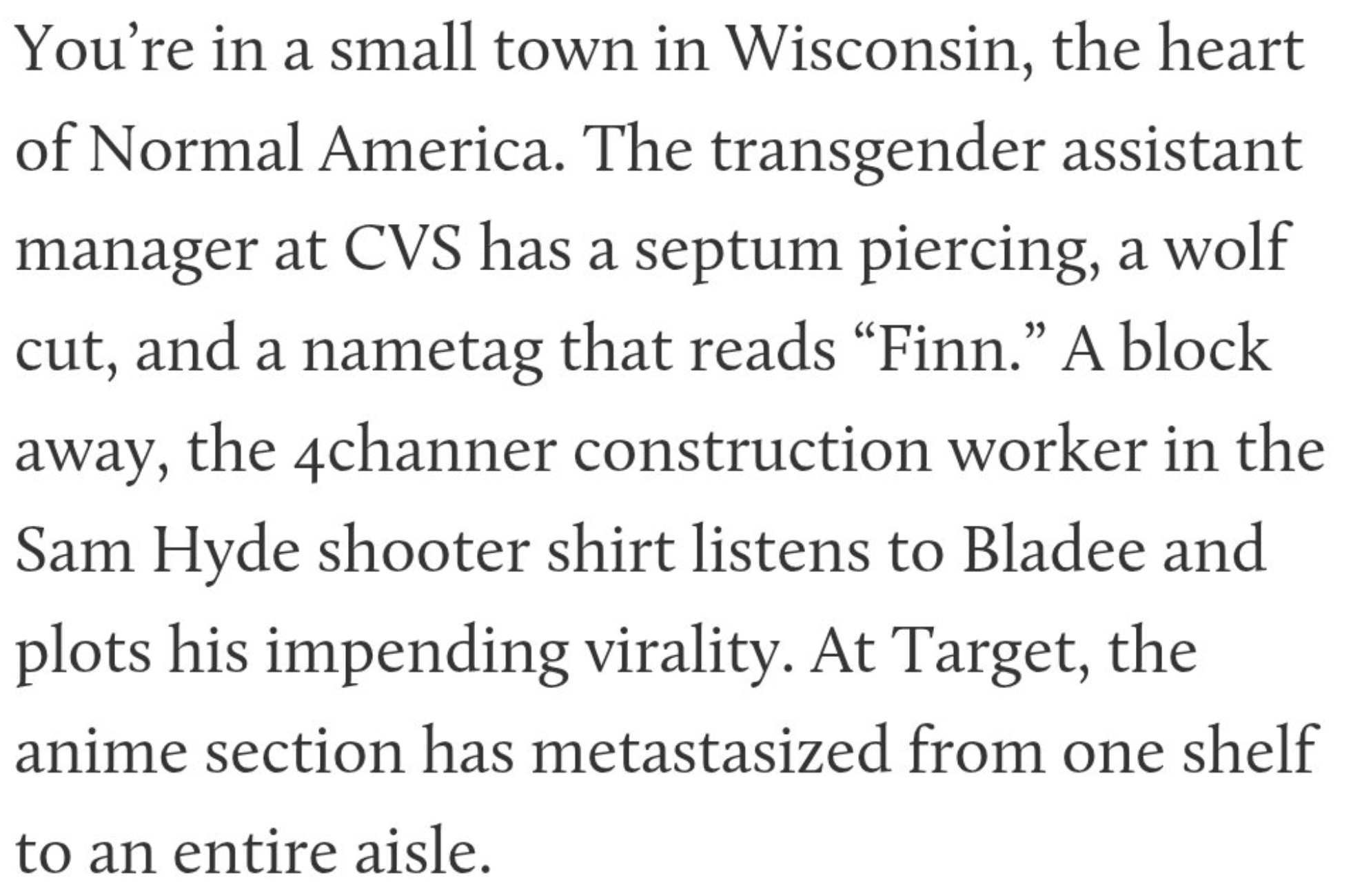
Millions of people read about about the Diner Goth on X last week. Which is an alt-coded version of the downwardly mobile. Think anime references, elaborate pronouns, septum ring, dyed hair, Discord humor, hyper-specific internet taste, but attached to a life with very little actual movement in it.

Then there is the NEET (not in employment, education, or training). Someone who has more or less withdrawn from public life. He's not downwardly mobile so much as he's opted out of the mobility system entirely.
@pickle_chrome_slayer I think in another life I am a NEET #NEET #unemployed #homeless #freedom
In an earlier era, this kind of failure looked different. A remarkable amount of twentieth-century art centered on the downwardly mobile man, and he was often the protagonist. When a man doesn’t have a job, anything can happen to him. The slacker, the drifter, even the burnout still had a world to move through. You can see it in the early 1990s cheap-rent of The Big Lebowski, or in the early 2000 scheap rent of London of Peep Show.
That world is mostly gone. Cheap cities barely exist anymore. A person can no longer sustain even a decent urban life on intermittent work, low wages, or half-serious employment. A person who falls now does not usually fall into some loose urban underworld. He falls back into the suburb, the childhood bedroom, the screen.
The internet has also killed boredom. Public life in many areas is thinned out. A man who once might have wandered now scrolls. Downward mobility no longer offers the old consolations of adventure. It offers only private stagnation and physical stillness.
The Dream Is to Stop Climbing
The irony to all this is if you make it in America, your descendants often become downwardly mobile by choice.
The first generation immigrant opens the store, buys the franchise, works insane hours. The second generation focuses on education and money, fields like law, medicine, finance, engineering, that is secure, prestigious, and well paid.
Then, if things go well, the third or fourth generation is the one that becomes a writer, an artist, a nonprofit worker, a photographer. Basically someone who chooses work for meaning, taste, or freedom rather than income.
That is the shape of the American dream. It was never meant to produce an endless line of strivers. It was meant to produce enough surplus that someone, eventually, could step off the ladder.
If you find yourself downwardly mobile, there are three basic responses.
1) Accept It. Stop treating money as the only measure of whether a life is going well. Build dignity somewhere else.
2) Leave It. Take whatever you have and go where the same income buys more room, more time, and a lighter life.
3) Fight It. Turn the frustration outward. Join political movements that promise to make decline less brutal and ordinary life more secure.
