- The Lindy Newsletter
- Posts
- From Option to Obligation
From Option to Obligation

Paul Skallas
December 16, 2025

There are two conflicting strands of thought running through public life right now.
The first says progress is real and undeniable. We are richer than ever. We live longer. Diseases that once killed millions are now manageable or curable. Technology works. Material comfort has expanded. By almost any measurable standard, life has improved. Stop complaining so much. Kings would be envious of your life.
The other story says something feels wrong. People are anxious. Managed. Exhausted. Housing is unaffordable. Healthcare is opaque. Education feels like a scam. Everyone is nostalgic for decades they barely remember. Modern life feels airless despite all the upgrades.
These stories are treated as opposites. You’re supposed to pick one. Either progress is fake, or people are weak. Either things are broken, or people are whining.
Both sides miss what's actually happening.
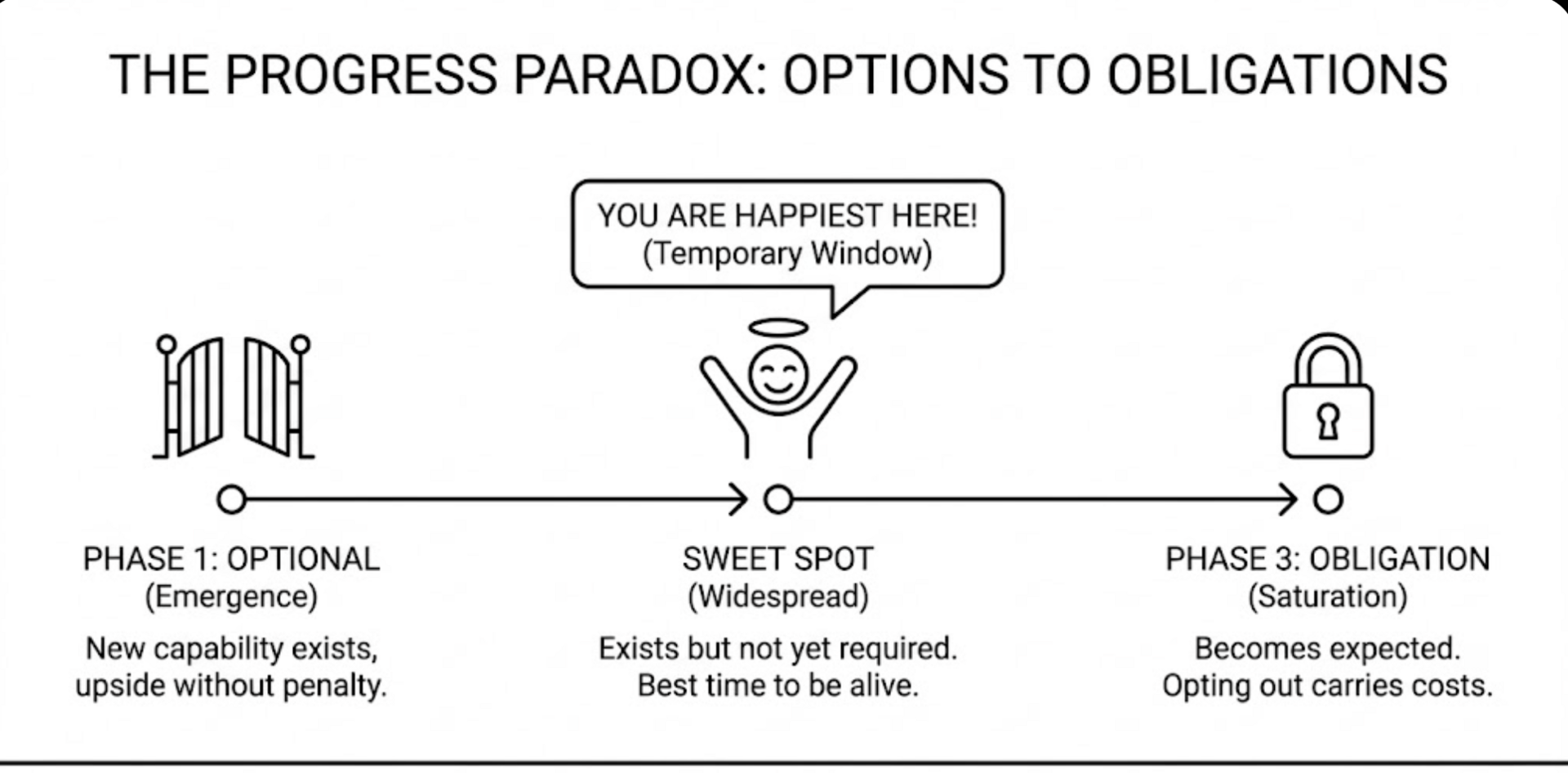
Progress has an inherent quality in it. It converts options into obligations.
And when optionality disappears, freedom feels like it has shrunk, even as life improves.
In Praise of Cafes and Drinks
You can see this in small, personal situations.
Ad man Rory Sutherland writes about this. Dinner parties are risky. If they’re good, they’re great. If they’re bad, you’re trapped. Leaving feels rude. You sit there for hours, nodding, checking your phone under the table. Drinks are different. You can stay. You can leave. The exit is visible. That’s the pleasure. Expectations tend to ruin things.

Take the cellphone. You don’t “have” one anymore. You need one. To pay. To enter buildings. To do your job. To maintain relationships. In 2006, only about half of people carried a phone at all times. Today it’s closer to universal. The device didn’t change. The expectation did.
This pattern repeats everywhere. Change whether technological, social, cultural, arrives as an option, spreads as convenience, and hardens into requirement.
When the internet arrived, you could ignore it. Or you could use it. It was up to you. Now it’s where work happens. Where services live. Where social life is coordinated. Try opting out. See how that goes.
It’s like that David Bowie interview in 1999 where he saw what was coming, but the interviewer thought the internet would just remain an elective tool. It didn’t.
@gc32250 David Bowie explains his thoughts on the internet #davidbowie #singer #retro #Internet #interview
The best moment is that brief window when the new thing exists but isn't yet required. You have it but nobody expects it from you. That's when it feels like progress. But that window closes fast. This explains why people can simultaneously acknowledge life is better by every metric and feel like they've lost something. They have. They've lost the optionality window.
Modern Options to Obligations
Because progress has accelerated, many things are crossing from option to obligation at the same time. That’s why the pressure feels everywhere.
If you’re single, you’re expected to be on dating apps. Other paths still exist, but they’ve atrophied. Staying off the apps means accepting a dramatically smaller pool.

The apps impose their own constraints. You can’t be too strange, too particular, too niche. Profiles converge toward universal appeal, the same interests, the same photos, the same carefully curated normality. Single people are obligated to be legible to everyone.
People in relationships only need to be liked by one person who already chose them. They’re free to be strange again.
If you want economic security, you may need a college degree. Jobs that once required a high school diploma now demand a bachelor's. Opting out means narrower opportunities and lower earning potential.

If you want a middle-class life, you likely need two incomes. Housing, childcare, and healthcare have adjusted to assume it. The same standard of living your parents achieved on one income now requires two.
@mindset.to.mills It used to be a lifestyle choice—now it’s a necessity. 💸 This video breaks down how the two-income household went from optional upgrade to... See more
If you want to build a career with real upside, you need expensive cities. Cheap rent in New York or San Francisco is gone, but the networks are still there. You can't opt out of the cost anymore.

The pattern repeats everywhere. Intensive parenting is expected, being active on LinkedIn is expected for careers, etc. What makes progress feel burdensome is the obligation just often just gets you back to baseline. You run faster just to stay in place.
Opportunity concentrates at the transition point. Whenever something shifts from option to obligation, friction appears. People resent the new requirement, struggle with it, quietly look for ways around it. That irritation doesn’t stay abstract for long. It condenses into markets. Sometimes they are political markets.
Donald Trump’s 2024 campaign relied heavily on explaining to voters that previous options are now obligations. DEI initiatives, pronoun sharing, sensitivity training, immigration, these spread rapidly through institutions. Many felt they couldn't opt out without penalty, Trump said he would “roll back those obligations”. People voted for him.
Some people make money smoothing the adoption, building tools that make the new obligation feel painless, normal. Others profit by offering escape hatches, opt-outs, workarounds, substitutes that let you pretend you’re not fully inside the system yet.
Acceleration and resistance both monetize well
Why the Future Never Feels Like the Future
This dynamic also explains why the future never feels like the future.
Look around, we are clearly living in a sci-fi world. But it doesn’t feel like one. The future isn’t an aesthetic. It’s a moment. Specifically, it is the moment when new capabilities exist without being required.
When something is optional, it feels futuristic. Look at this thing I can choose to do. Video calls, AI tools, self-driving cars feel like the future precisely because you can use them, or not.
@crisaranguren6 Living in Arizona feels like the future 🚀 @Waymo driving itself while I just sit back and watch. 2050 vibes today. #waymo #arizona #tech #... See more
The moment those same technologies become mandatory, they stop feeling futuristic. They become infrastructure. Plumbing. You don’t feel like you live in the future when you’re forced to download an app to park your car. You feel annoyed.
This is why the 1980s and 1990s still look like “the future” in our cultural imagination. Not because the technology was more advanced, but because it was elective.
A personal computer, a Walkman, a car phone, none were required to function socially or economically. Technology sat on top of life as an addition, not underneath it as a system you had to comply with.
The true feeling of the future isn’t more stuff. It’s release. Without release, progress just feels like pressure.
Which brings us to AI. What makes AI interesting is it could be something different.
If AI actually reduces the necessity of work, if it lets you meet basic needs without constant performance, then optionality doesn't have to disappear. The future doesn't have to become infrastructure. Work stays elective. The sweet spot stays open. We in, in a sense, will be feeling like we are living in the future. This is the scenerio Elon Musk thinks will happen
@apnews Elon Musk predicts AI and humanoid robots will lead to work being “optional" and money “irrelevant.”
If AI only raises expectations, faster output, higher baselines, more surveillance, then it will feel like every other upgrade. Another phone. Another obligation. No future feeling.
That’s the fork. Not robots versus humans. Optionality versus infrastructure.
The Mechanics of Obligation
Obligation is a deceptive term because it rarely looks like force. You can technically opt out of smartphones, college, or the big city. No one is holding a gun to your head.
It just becomes inconvenient. Expensive. Embarrassing.
Obligation doesn’t arrive with force. It arrives with scale.
