- The Lindy Newsletter
- Posts
- Love Will Change the World
Love Will Change the World

Paul Skallas
March 10, 2026
How often do you think about Love?
Modern society is built on a single romantic assumption. You probably haven't thought about it. You should.
Two people meet. They fall in love. They couple up. They buy a home, have children, raise them, and eventually retire side by side. Modern life flows downstream from that sequence. The two-income mortgage. The tax structure. The real estate market. Universities. The suburbs. The school system. The pension system.
If this chain gets broken, things start collapsing.
Most people assume expensive housing is preventing marriage. The research suggests it's the reverse. Marriage decline is driving homeownership decline. The couple is an economic engine. When it stops forming, the downstream systems built on top of it start contracting, and the real estate market is just the first place it shows up.
And the couple is forming less often.
It starts with dating, and something has gone terribly wrong with dating. Over two-thirds of young adults have barely dated in the last year. Approximately 42% of U.S. adults are currently single. It is significantly higher than 29% in 1990. In 1990, there were roughly 67 million single adults, today, there are over 100 million. No one knows how to fix this.
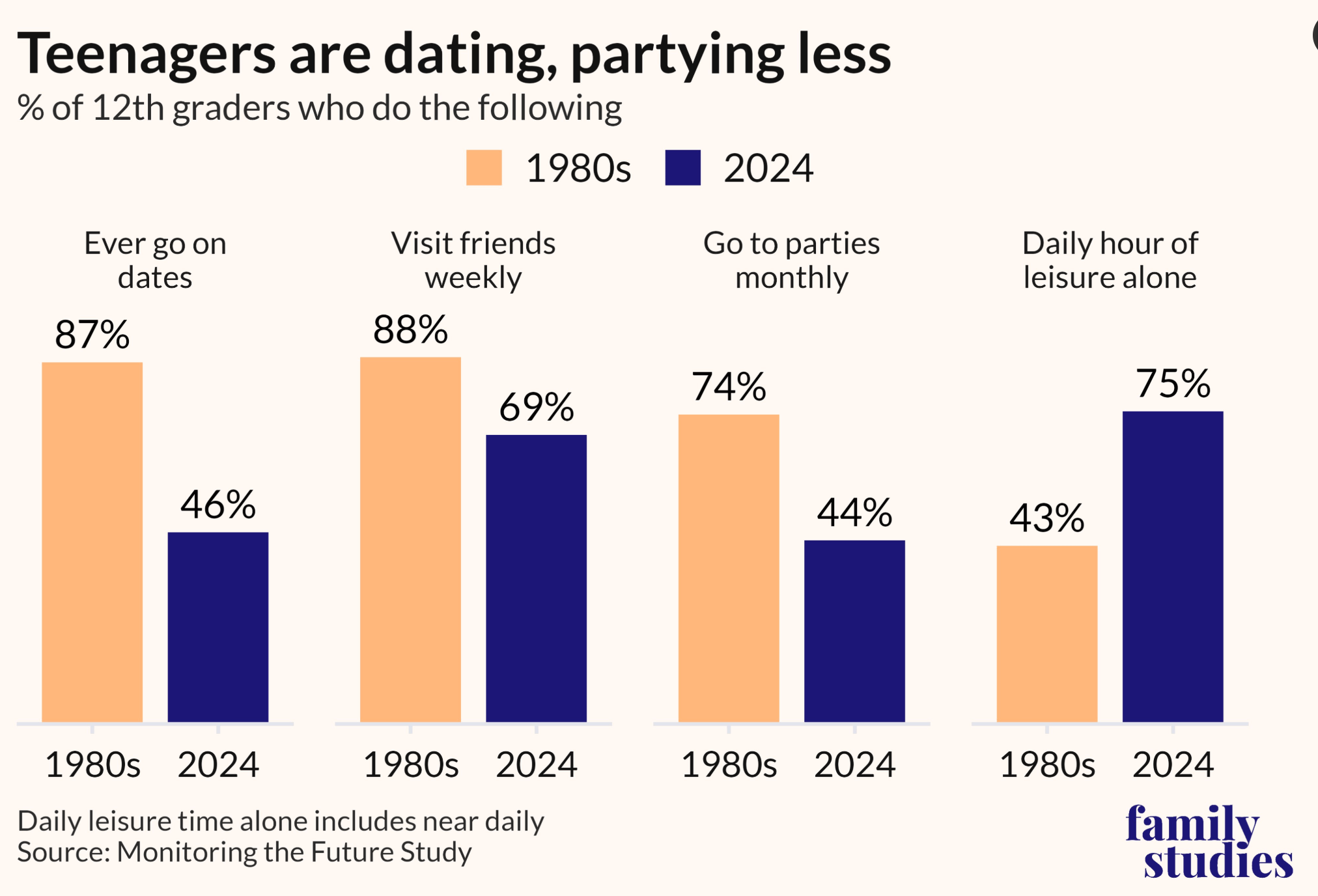
A growing share of adult life is now being lived outside the traditional two-person unit.
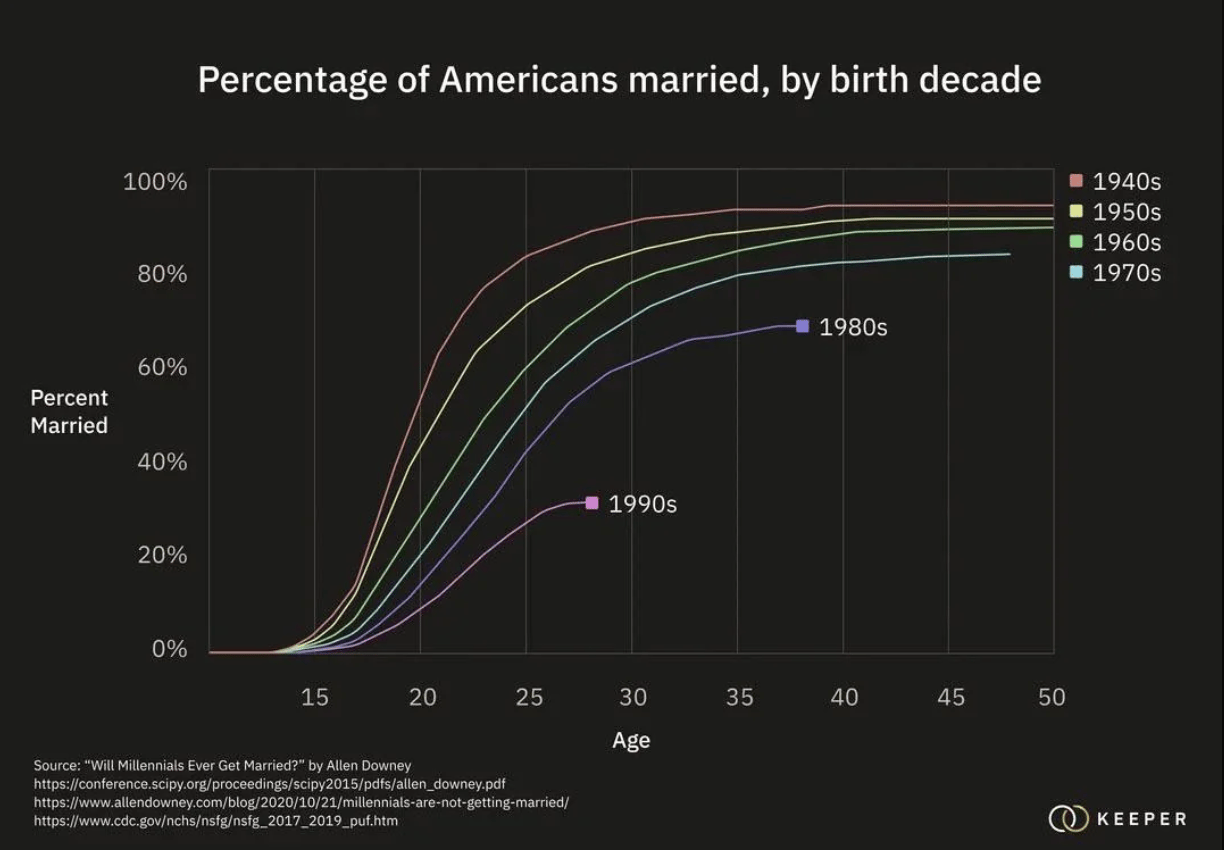
The couple is the load-bearing infrastructure of modern society. And the infrastructure is cracking. It’s harder than ever to get into a relationship, and no one knows how we can make it easier.
The Necessity of Love
For most of human history, marriage didn't have to clear a very high emotional bar. Marriage was organized around economics, property, lineage, status, and survival. Love arrived sometimes. But it arrived as a bonus, not a prerequisite. Romantic love is NOT a universal value. In the
Now Love is necessary.
Marriage has stopped being economically necessary, now romance has stopped being optional. A woman who can support herself, travel alone, build a career, and live without stigma outside marriage does not need a husband the way her grandmother did. A relationship now has to offer something autonomy does not. It has to feel better than being alone.
We now ask one person to be what an entire village once provided, lover, best friend, therapist, and financial ally. This has made courtship less predictable and the stakes impossibly high.
The Sex That Changed
Everyone seems to focus on how men are changing. The male crisis, the manosphere, the lost boys, the angry young men. Some of that is real. But historically speaking, the larger structural transformation is not with men.
They’re wrong. The basic male template is old. Zoom out far enough and men look remarkably stable, they still want what men have always wanted. Status, sex, companionship, respect from other men, desire from women. Read the Iliad or the Odyssey and you are reading about rivalry, honor, ambition, temptation, exile, and the struggle to become the kind of man others will follow. That was three thousand years ago.
Women changed more radically.
Within a single lifetime, women moved from a world that funneled them toward marriage as an economic necessity to one in which they can earn, travel, choose, delay, refuse, specialize, compete, and build a complete life without a man at the center of it. That is one of the most dramatic social transformations in human history.
You can see the same thing in who wants children. We used to assume women wanted kids more than men. Recent data suggests it is now the reverse. Men, it turns out, want families. Women are less certain. That's a reversal of one of the oldest assumptions in human civilization.

It’s not even an American thing. It’s happening in Japan as well. It’s happening in every country.
Coupling is declining across the world, not just in Europe and America, but in places like Korea, Turkey, and Iran, where marriages have fallen sharply in recent years. Smartphones and social media expanded the horizon of possibility, especially for women, making visible forms of life that earlier generations rarely imagined. Female ambition widened, the threshold for partnership rose with it.
Liberation and a Thousand Identities
There is no longer a default female path, and so there is no longer a default woman.
For most of history, female individuality operated within a narrow corridor. You could roughly predict what a woman wanted because the options were roughly the same.
Now, there is just way more TYPES of women today than ever before. That’s exactly what liberation does. It takes an individual and gives them a thousand roads of freedom.
There is the woman who wants family but refuses to settle without real desire. The woman who built a full life and sees no reason to downgrade it for a mediocre relationship. The woman who wants tradition. The woman who wants total equality. The woman who wants to be led. The woman who wants an equal who can keep up. The woman who wants emotional depth. The woman who wants levity. The woman who wants roots. The woman who wants movement. Some want adventure. Some want peace. Some want to be seen so specifically it almost feels uncomfortable.
I once posted about dating female doctors on Twitter and got hundreds of responses. Men seemed convinced that female doctors formed a recognizable type. Maybe they do, maybe they do not. But the revealing thing was that men now think in these subcategories at all.
As women’s lives diversify, courtship becomes less standardized. Men are no longer encountering one broad template of female adulthood, but a growing number of distinct female worlds, each with its own rhythms, expectations, and constraints. The woman in medicine, the woman in law, the creative freelancer, the corporate climber, the trad wife aspirant, the remote-worker nomad. They are different relationship markets.
Women Want Love
What do women want? Love. That’s what they all have in common.
Look at what women consume.
Romance novels outsell every other fiction category combined. By a significant margin. The readership is overwhelmingly female and it is enormous and it has been growing for decades. Women will read five hundred pages about two people trying to find their way to each other and consider it time well spent.
Then there is pop music. The most streamed songs in the world are almost entirely about love, falling into it, losing it, wanting it back, being destroyed by it. The artists women make into cultural phenomena, Taylor Swift selling out stadiums for years, Beyonce, Adele, are fundamentally love storytellers.
Love is not distributed evenly. It is not guaranteed. It is intense and relatively rare. So if a society says that marriage must now be justified by real desire, chemistry, emotional fulfillment, and personal meaning, it is effectively tying a mass institution to a scarce experience. Big changes are coming.
The Structure of Love
If Love is the basis for marriage and kids now, we may as well learn about it. It actually has a structure and has been written about before. There are few good books that are worth reading about how it works.
They all circle around to 5 phases that most relationships go through. If you have been in love you will recognize this pattern. If you haven’t, you’ll see it when it happens to you.
Phase 1: Ignition
The first gate is not compatibility. Leading with it too early is one of the most common mistakes modern daters make, and it is inherently anti seductive.
At the beginning, the task is simpler and more primitive, you must become vivid.
You do not need to be universally appealing. You need to register at a higher resolution than the background. You need some quality that activates attention. If the surrounding world feels grey, administrative, and flattened, then add color. At this stage attraction should feel like an event. The imagination awakens when something stands apart from the expected pattern.
Stendhal wrote that attraction begins with crystallization. The moment another person’s imagination starts discovering more in you than you have explicitly shown. You have not changed. But you have become the surface onto which their attention projects something larger.
What produces this is self-possession. People are drawn to those whose lives already possess shape, momentum, and standards of their own. Neediness is anti seductive. It sends a clear signal that there is nothing else here. No other life. No prior world to be invited into.
This is what a great deal of pickup artist language was groping toward. Teasing is treating someone as an equal worth sparring with rather than a prize. Outcome independence means not letting your emotional state depend entirely on how this particular interaction resolves. The willingness to walk away signals standards, I want this, but not at any cost. The element of challenge means not being instantly won over, instantly available, or instantly compliant.
These all point to the same thing, a person who already has a life, and is inviting you into it rather than asking you to become it.
Phase 2: The Seduction
Desire needs distance to survive.
Most people collapse this phase out of anxiety. They overexplain. They follow up too quickly. They make themselves entirely available. Premature transparency.
Stendhal describes a second crystallization at this time. A stage in which desire intensifies through doubt. The other person’s feelings are not yet fully known. The outcome is unresolved. Most people rush to eliminate that uncertainty through contact. But doubt is not the obstacle. It is the engine. Certainty, arrived at too early, kills the process before it completes.
