- The Lindy Newsletter
- Posts
- Reputation and the Collapse of the Backstage
Reputation and the Collapse of the Backstage

Paul Skallas
February 05, 2026

Reading through the latest Justice Department release of the Epstein emails, it’s clear that Epstein functioned as a broker for an elite network where he provided young women, capital and high level access to various people. That’s already been known.
But I didn’t expect his network to be so early. His emails from 2012 read like they could have been written yesterday.
The things Epstein was discussing and funding in the early 2010s like Artificial Intelligence, Bitcoin, Biohacking, Longevity, Eugenics, Psychedelics, Digital Nomadism, Offshore Lifestyles, Micropayments in Video Games, SPACs, Humanoid Robots, all became mainstream discourse in the 2020s.
In many domains, they saw around corners. But there was one thing they didn’t anticipate. They didn’t anticipate how fragile their reputations would become.
Many of the people in this network spent decades building pristine public images. Prestigious academics. Doctors. Scientists. Writers. Cultural figures. They had to. That's how you get access to those rooms. That's how you climb in the world.
And when exposure arrived, those reputations declined with startling speed.
The Reputation Trap
An unfortunate feature of modern life is that to have any success you need a good reputation. A good reputation gets you hired, gets you invited, gets you opportunities. Reputation opens doors, creates momentum, attracts attention. It can change your life.
In that sense, reputation behaves a lot like luck. Powerful, but essentially out of your control.
This is not a new problem. Ancient philosophy treated reputation the same way it treats other things that do not belong to us.

That’s because reputation exists entirely in other people’s minds. You can influence it, but you cannot govern it. And because you don’t own it, it can be destroyed in a single day, a truth made obvious by the Epstein emails, but one that plays out constantly at smaller scales as well.
As a result, people obsessively manage their reputation. But this creates real problems.
It limits freedom. You become a servant to your own image, constantly calibrating behavior to protect it. The performance is exhausting, and over time it shows.
It also creates a tactical weakness. If you face someone who doesn’t care about their reputation, they hold the advantage. They can say and do things you can’t. They move freely while you remain constrained by appearances.
But the most dangerous reason is cultivating a good reputation almost inevitably creates a gap between your public image and your private behavior.
And that gap is where you become vulnerable in modern life.
Integrity > Reputation
The Lindy solution to this problem is integrity.
Integrity means goodness plus alignment between your private and public selves. It means not committing injustice. It means acting morally even when no one is watching. It is, without question, the most stable way to live.
In an ideal life, reputation would be a byproduct of character, not a goal pursued directly. Most things worth having work this way. The goal is not the goal, the byproduct is the goal. For example, Happiness comes from living well, not from chasing happiness
Creativity is a byproduct of innate interest.
But integrity requires genuine choice
Most people believe they have integrity because they’ve never had to truly test it. Our society supplies constraints that enforce decent behavior. Middle-class obligations, legal consequences, workplace norms, social pressure. In reality, constraints do much of the work that integrity would otherwise have to do. Break enough norms and you fall off the middle-class hamster wheel.
Only a small minority ever face the real test, those with enough money, insulation, and freedom that constraints no longer bind them. They can act without immediate consequence. At that point, integrity becomes a choice rather than a requirement.
The Epstein emails are revealing not because they show universal depravity, but because they show behavior under extreme freedom.
So we hit a problem.
What if you want to be a public figure, or at least prominent in your local network, but you know, honestly, that you don’t have integrity? Not hypothetically. You’ve looked. It isn’t there.
Are you doomed to manage your reputation forever?
Until recently, yes.
But the environment changed.
Consistency Protects People Without Integrity
A third option emerged. Consistency.
If you can’t be good, just be the same in every part of your life.
Consistency is amoral, but protective. It removes the gap between private behavior and public presentation. In today’s environment, the public punishes contradiction far more than it punishes vice.
Look at Donald Trump. He has lived inside constant scandal for decades, personal controversies, public chaos, nonstop exposure. None of it weakens him. If anything, it strengthens him. Trump lacks integrity but has consistency. His public persona matches his private behavior closely enough that revelations don’t shock the public. Even his association with Epstein failed to damage his standing. There was no contradiction to exploit.
The people in the Epstein emails had the opposite problem. They built their careers on pristine reputations, this carefully managed public image. But the gap is destroying them right now, people like Deepak Chopra (wellness guru), Peter Attia (longevity doctor), Brad Karp (white-shoe lawyer), Peter Mandelson (British politician), Noam Chomsky (Leftist intellectual), Bill Gates, and many others are facing intense criticism because of this gap between private and public life.
The same logic explains why figures like Andrew Tate absorb repeated scandals without losing support. He never claimed virtue. He never projected moral authority. No pristine image existed to undermine.
This dynamic is new. It emerges from a media environment where the backstage and front of the stage has collapsed into a middle ground that demands consistency.
The Collapse of the Backstage
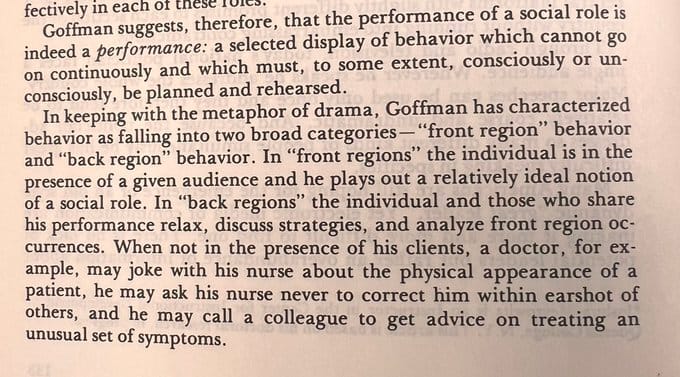
For most of history, your "back regions" (private life) and "front regions" (public persona) were separated. You could be two different people depending on the circumstance.
Sociologist Erving Goffman described this as the basic structure of social life. Frontstage and backstage behavior, each appropriate to its setting.
A waiter behaves one way in the dining room, polished, polite, and a totally different way in the kitchen. You talk differently at work than at a bar with friends, and differently at home with your partner than when the kids are around. This is normal behavior.
That balance held for most of history. But electronic media came along and changed it.
In 1985, during the height of Television, Joshua Meyrowitz argued that electronic media would begin to dissolve that structure. In the book No Sense of Place, he predicted the emergence of a “middle region,” where private behavior would increasingly leak into public view, where the kitchen and the dining room would merge.
In this environment, he argued, people would gravitate toward figures with little difference between their public and private selves, and grow suspicious of those who behaved differently across settings.
At the time, this referred mainly to television. But the smartphone and social media accelerates this process. The smartphone and social media is like a super-television. Always on, always connected, always within reach. Behavior taken in one setting resurfaces in another.
We no longer move between roles. We perform continuously.
In this environment, consistency becomes the only viable armor. In the middle region, the worst thing you can be is inconsistent. You can survive almost any scandal through sheer wholeness, by ensuring the person you are in private matches the person you are in public.
Other Consequences of the Middle Region
The collapse of the backstage did not just change how scandals work. It rewired other domains of life.
Take the privacy of the family as one example.
Traditional Life is Now Public
In earlier eras, living “tradition” meant keeping family life private. Marriage, children, religion, and domestic routine belonged to the backstage. Public identity focused on work, status, or civic role. The family existed, but it did not need to be exhibited. Privacy and the family life was sacrosanct.
In our new middle region world, that logic reverses.
To be “traditional” now often means making the private visible. Marriage, children, home life, and religious practice move onto public platforms, shared, posted, and documented. Family life becomes a consistency signal. It tells the audience, this is who I am everywhere, not just in public.
This is a profound shift
